

The Philippines Typhoon 2025, officially named Typhoon Kalmaegi, left at least 114 dead and over 400,000 displaced across Cebu and nearby provinces. Discover the storm’s path, damage reports, relief operations, and how climate change is intensifying typhoons in the region.
🌪️ Philippines Typhoon 2025: Unprecedented Flooding and Loss in Cebu
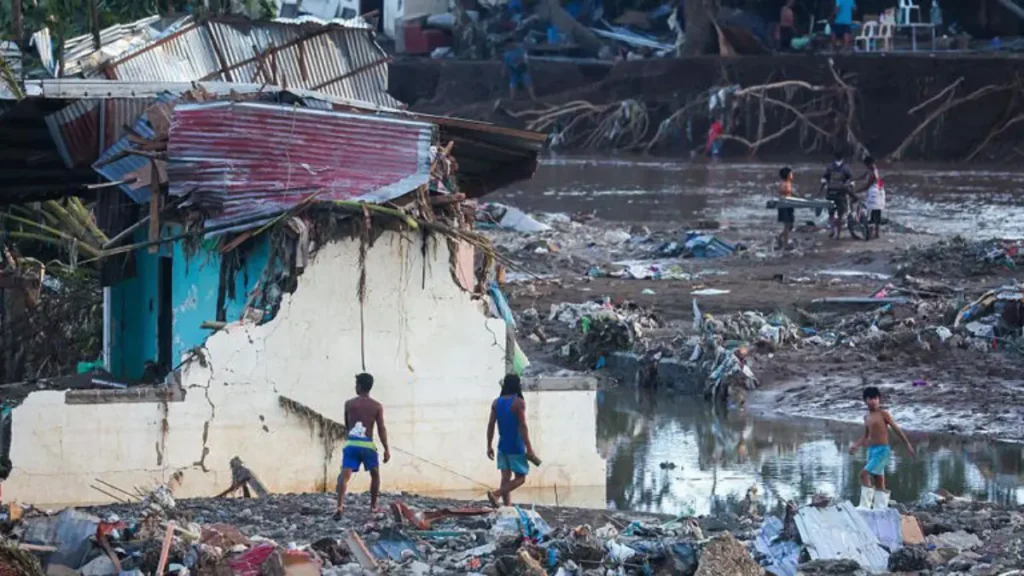
The Philippines Typhoon 2025, known internationally as Typhoon Kalmaegi, has emerged as one of the deadliest and most destructive storms of the year. Striking the central region with torrential rain and winds exceeding 150 km/h, it caused catastrophic flooding in Cebu, killing at least 114 people and leaving over 400,000 displaced.
Local and national authorities described the flooding as “unprecedented”, with entire communities submerged and rescue operations stretched beyond capacity. As the Philippines recovers from this tragedy, the world is once again reminded of the growing threat of extreme weather fueled by climate change.
🌊 Typhoon Kalmaegi’s Path Across the Philippines
| Region | Impact | Reported Deaths | People Displaced |
|---|---|---|---|
| Cebu Province | Massive flooding, infrastructure collapse | 71 | 300,000+ |
| Mandaue City | Residential damage, waist-deep floods | 12 | 50,000 |
| Mindanao Island | Helicopter crash during rescue mission | 6 | — |
| Bohol | Landslides, power outages | 9 | 25,000 |
| Total (National) | — | 114+ | 400,000+ |
The Philippines typhoon 2025 began forming east of Mindanao before rapidly strengthening into a Category 4 storm. As it made landfall in the central islands, rivers overflowed and entire towns were submerged. Emergency services struggled to reach affected areas due to impassable roads and collapsed bridges.
⚠️ Widespread Damage and Humanitarian Crisis
The aftermath of the Philippines typhoon 2025 is staggering. According to the National Disaster Risk Reduction and Management Council (NDRRMC), more than 2,000 homes were completely destroyed, and thousands more were partially damaged.
Residents in Cebu described scenes of chaos as floodwaters rose rapidly:
“We didn’t even have time to pack. The water came rushing into our house within minutes,” said Jel-an Moira Servas, a resident of Mandaue City.
Key Impacts of Typhoon Kalmaegi (Philippines Typhoon 2025):
- 114 confirmed deaths and over 127 missing persons
- 82 injured across various provinces
- 400,000+ people displaced in temporary shelters
- Millions of pesos in agricultural losses
- Electricity and communication outages in multiple regions
This Philippines typhoon 2025 has been compared to 2013’s Typhoon Haiyan (Yolanda) due to the scale of destruction, though Kalmaegi’s flooding was more localized to the Visayas region.
🌧️ Why Cebu Was Hit So Hard
Cebu, the most populous island in central Philippines, was particularly vulnerable due to its low-lying urban centers and inadequate drainage systems. Despite early warnings, many residents underestimated the storm’s strength.
Factors Behind Cebu’s Severe Flooding:
- Intense Rainfall: Over 400mm of rain fell within 24 hours.
- Urban Development: Concrete sprawl limited natural drainage.
- Deforestation: Reduced watershed capacity led to faster runoff.
- Aging Infrastructure: Incomplete flood control projects failed to withstand the storm.
The Philippines typhoon 2025 exposed systemic issues in disaster preparedness and highlighted the urgent need for better urban planning.
🌍 Climate Change and the Intensifying Typhoon Season
Meteorologists have linked the intensity of the Philippines typhoon 2025 to a warmer Pacific Ocean, which fuels stronger tropical cyclones.
The Philippines, being part of the Pacific “Typhoon Belt,” faces an average of 20 storms annually, but recent years have seen an increase in their frequency and severity.
Experts warn that climate change is amplifying rainfall, extending typhoon seasons, and displacing more families each year.
The Philippines typhoon 2025 serves as a grim reminder that adaptation measures are urgently needed — from stronger infrastructure to improved early warning systems.
🚁 Relief and Rescue Operations
In response to the Philippines typhoon 2025, both local and international organizations mobilized massive relief efforts. The Philippine Red Cross, military, and private volunteers worked tirelessly to rescue stranded families and deliver food, water, and medicine.
However, tragedy struck when a military helicopter crashed in Mindanao during a relief mission, killing six crew members.
Current Relief Actions:
- Deployment of 8,000+ rescue personnel
- Establishment of temporary shelters across Cebu and Bohol
- Distribution of emergency food packs and hygiene kits
- Foreign aid from Japan, the U.S., and the European Union
Despite these efforts, many communities remain cut off due to blocked roads and destroyed bridges, complicating the delivery of critical aid.
🏠 Stories of Survival and Hope
Amid the devastation, countless stories of heroism and solidarity have emerged. Local youth volunteers, church groups, and fishermen joined forces to rescue trapped residents.
One rescuer, Carlos Jose Lañas, shared his experience:
“This is the worst flood I’ve ever seen. Almost all the rivers overflowed. Even emergency teams couldn’t reach everyone.”
As the sun returned over Cebu, residents began rebuilding their homes from the mud and debris, demonstrating the Filipino spirit of bayanihan — unity in adversity.
📊 Comparison: Typhoon Kalmaegi vs. Previous Philippine Typhoons
| Typhoon Name | Year | Max Winds (km/h) | Deaths | Primary Region Affected |
|---|---|---|---|---|
| Haiyan (Yolanda) | 2013 | 315 | 6,300+ | Eastern Visayas |
| Rai (Odette) | 2021 | 195 | 410 | Central Visayas |
| Noru (Karding) | 2022 | 195 | 114 | Luzon |
| Kalmaegi (Tino) | 2025 | 155 | 114+ | Cebu & Central Philippines |
While not as strong as Haiyan, Typhoon Kalmaegi ranks among the deadliest in recent years, mainly due to flooding rather than wind damage.
🌏 International Response and Long-Term Recovery
Global leaders expressed condolences and pledged support to the Philippines. The United Nations Office for Disaster Risk Reduction (UNDRR) is coordinating international aid, while the World Bank has offered emergency financial assistance.
The government has vowed to accelerate flood control projects and implement stricter urban planning policies. Rebuilding homes, restoring power, and rehabilitating farmlands will take months, if not years.
The Philippines typhoon 2025 underscores the need for climate resilience—through early-warning systems, sustainable drainage design, and stronger disaster education.
❓ FAQs About the Philippines Typhoon 2025
1. What was the cause of the Philippines Typhoon 2025?
The typhoon formed from a tropical depression over the Pacific Ocean and rapidly intensified due to warm sea surface temperatures.
2. Which area was worst affected?
Cebu Province suffered the heaviest casualties and flooding, followed by Bohol and Mindanao.
3. How many people died in the Philippines Typhoon 2025?
Official reports confirm at least 114 deaths, with over 127 still missing.
4. How does this typhoon compare to previous ones?
While not the strongest, it was one of the deadliest floods in central Philippines since 2013’s Typhoon Haiyan.
5. What is being done for survivors?
The government, NGOs, and international partners are providing shelters, food, and financial aid, while long-term recovery efforts are ongoing.
🧭 Conclusion
The Philippines typhoon 2025 has once again revealed the country’s vulnerability to natural disasters. As Cebu and surrounding provinces rebuild from the devastation of Typhoon Kalmaegi, there is a renewed call for action — not only for immediate relief but also for sustainable climate resilience.
Investing in infrastructure, enforcing zoning laws, and improving community preparedness will be crucial to prevent another tragedy of this magnitude.
Despite immense loss, the resilience of the Filipino people shines through — rebuilding lives, communities, and hope in the aftermath of yet another devastating storm.